
.svg)
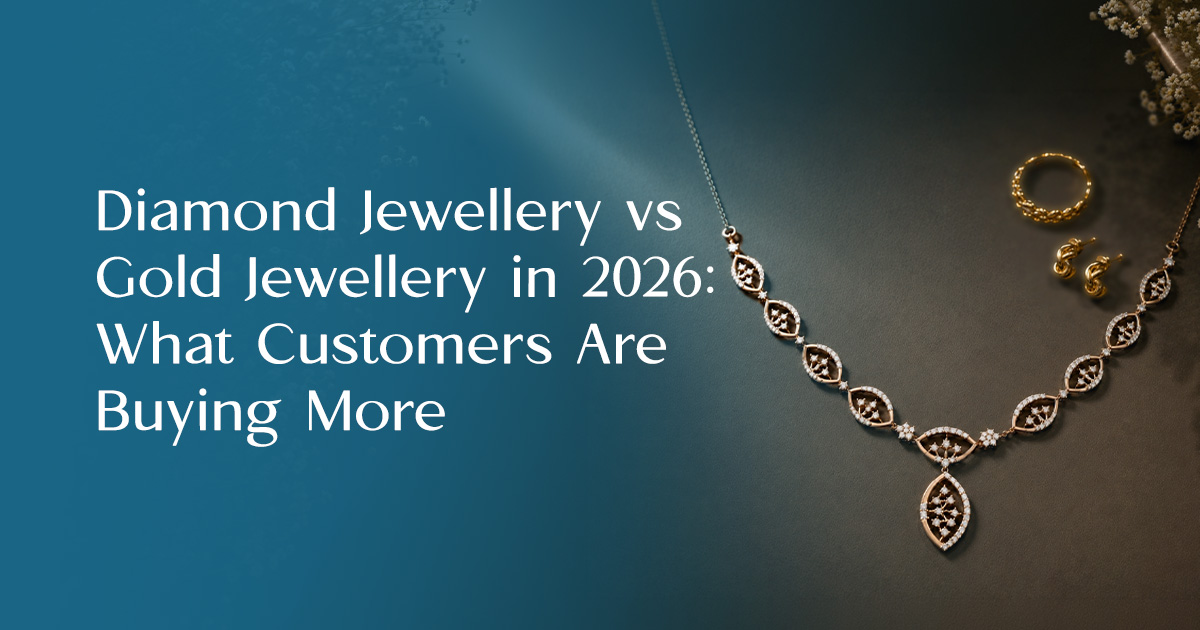
Diamond Jewellery vs Gold Jewellery in 2026: What Customers Are Buying More

April 15, 2026
In 2026, the comparison between diamond jewellery vs gold jewellery is shaped by how customers evaluate value within a defined spend.
At the retail counter, this evaluation plays out in real time, where pricing, design, and immediate usability come together to influence what a customer finally chooses to take home.
Gold Jewellery in 2026: Pricing and Purchase Control
Gold jewellery continues to hold strong relevance in wedding and occasion-led buying, where purity and weight carry meaning that remains deeply embedded in purchase decisions.
At the same time, sustained high gold prices have introduced a greater level of control in how customers select pieces, particularly in mid-range transactions where budgets are clearly defined before the purchase begins.
This often leads to smaller formats, adjusted designs, or extended decision cycles, where the intent to buy remains present while the final selection becomes more measured.
For retailers, gold continues to anchor high-value sales, with movement concentrated around planned purchases and specific occasions.
Diamond Jewellery in 2026: Clarity in Design and Pricing
Diamond jewellery is seeing stronger traction in segments where customers look for pieces that feel complete within a clear price range.
Categories such as daily wear diamond jewellery, light diamond rings, and pendants are moving steadily because they offer presence through design structure and proportion, allowing each piece to hold its identity across accessible price points.
For retailers, this creates a category that supports regular transactions, where customers are able to make decisions with greater ease and return for repeat purchases over time.
Customer Behaviour at the Counter
The shift becomes most visible in live selling.
A customer enters with the intent to buy a gold chain within a fixed budget, reviews options across weights, and begins to evaluate price against size. At this point, a diamond pendant within the same spend is introduced, offering a finished piece with defined design and immediate wearability.
In many such interactions, the decision moves toward the diamond piece alongside gold, as a selection that feels resolved within the same budget.
This pattern is becoming more frequent across self-purchase and gifting, where customers respond to how a piece fits into use from the first day.
Retail Impact: Movement, Margins, and Mix
For retailers, the difference between gold jewellery and diamond jewellery shows up clearly in sales patterns.
Gold contributes to higher ticket transactions tied to occasions, while diamond jewellery supports frequency through designs that move faster and encourage repeat buying, especially in categories that sit within accessible price bands.
Inventory built around diamond jewellery and lightweight collections tends to rotate more consistently, often turning multiple times within a season, while heavier gold pieces remain in the showcase for longer periods until occasion-led demand brings them into consideration.
This difference in movement allows retailers to maintain steady cash flow through diamond jewellery, while gold continues to contribute through fewer but higher-value transactions, creating a balanced structure across the store.
Diamond Jewellery Trends 2026: What Is Driving Demand
Proportion and finish determine how minimal formats perform within diamond jewellery trends 2026, where pieces developed with attention to structure, spacing, and setting hold stronger sell-through across retail environments.
Designs where these elements are resolved at the development stage continue to move with consistency, as they present a complete form that customers can respond to immediately.
This has increased the importance of working with a diamond jewellery manufacturer who can maintain design accuracy and finishing standards across volumes, particularly in categories that depend on repeat orders and steady retail movement.
Conclusion
The conversation around diamond jewellery vs gold jewellery in 2026 reflects a market that is expanding in two distinct directions.
Gold continues to hold its position in ceremonial and value-driven buying, while diamond jewellery strengthens its role in everyday retail, gifting, and self-purchase.
For retailers, this creates a clearer structure for building collections, where each category contributes in a different way, allowing the store to respond to varied customer intent while maintaining consistency in sales and inventory movement.
Explore More

Best Diamond Jewellery to Stock for Diwali 2026
.svg)
September 18, 2026
Learn what diamond jewellery retailers should stock for Diwali 2026, from minimal daily wear and gifting jewellery to festive, bridal and heavy diamond jewellery.
Read more
Best Diamond Jewellery for Festive and Wedding Season 2026
September 22, 2026
Learn how retailers can build a festive and wedding jewellery collection for 2026, from lightweight diamond jewellery and gifting pieces to statement and bridal designs.
Read more
How to Choose Diamond Earrings, Rings, Pendants and Necklaces for Your Collection
August 21, 2026
Learn how retailers can build a well-balanced diamond jewellery collection across earrings, rings, pendants and necklaces, with guidance on design, customer occasions and assortment planning.
Read more.svg)


